
Zohran Mamdani (born in 1990 in Kampala, Uganda) is an American politician, community organizer, and the first Muslim mayor of New York City. A member of the Democratic Socialists of America, Mamdani rose from relative obscurity to become one of the most dynamic and progressive figures in contemporary American politics.
Early Life and Education
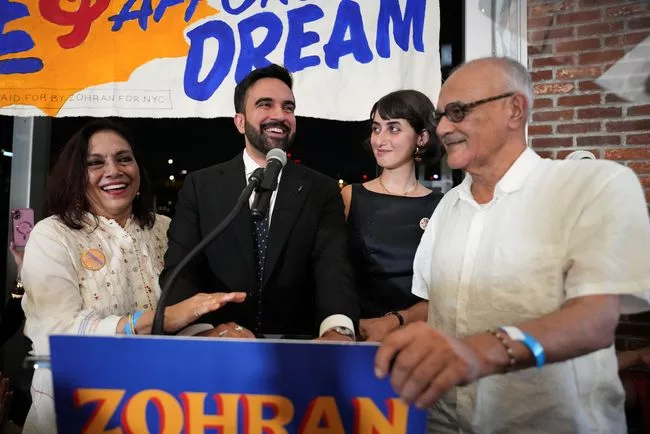
Mamdani was born in Kampala, Uganda, to Indian parents. His mother, Mira Nair, is an acclaimed filmmaker known internationally for works such as Monsoon Wedding and The Namesake, while his father, Mahmood Mamdani, is a renowned scholar and professor at Columbia University.
The family moved to New York City when Zohran was seven years old. He attended The Bronx High School of Science, where he co-founded the school’s first cricket team, reflecting both his multicultural background and community spirit. Later, he pursued Africana Studies at Bowdoin College, graduating in 2014. During his time there, he founded Bowdoin’s first Students for Justice in Palestine chapter — an early indication of his political awareness and activism for global justice causes.
Mamdani became a naturalized U.S. citizen in 2018, deepening his connection to the country he would later help lead.
Early Career and Political Beginnings
Before entering elected politics, Mamdani worked as a community organizer and foreclosure prevention counselor, roles that shaped his commitment to economic justice and housing reform.
In November 2020, he was elected to the New York State Assembly, representing the 36th District, which includes parts of Astoria and Long Island City in Queens. His victory was historic — he became the first South Asian man, the first Ugandan, and one of only three Muslims ever to serve in the New York State Assembly.
Rise to the Mayoral Office
In a few short years, Mamdani transitioned from a local legislator to a national political figure. His grassroots campaign for New York City mayor gained momentum through social media, where his creative and relatable videos resonated with young voters, immigrants, and working-class communities.
His platform centered on affordability, housing, public transit, and economic equality. Proposals such as universal childcare, fare-free buses, city-owned grocery stores, a $30 minimum wage, and higher taxes on the wealthy and corporations became the core of his populist message.
Mamdani’s campaign was marked by inclusivity — he spoke to voters in Urdu, Hindi, Arabic, and Spanish, often visiting mosques, community centers, and night-shift workers. His outspoken advocacy for Palestinian rights and defense of immigrants and minorities further distinguished him in New York’s political landscape.
Despite facing Islamophobic attacks and criticism from both Republicans and centrist Democrats, Mamdani’s movement inspired a surge in voter turnout, especially among first-time and young voters. His victory over former governor Andrew Cuomo, who ran as an independent backed by corporate donors, was widely regarded as a turning point for progressive politics in New York.
Personal Life
Zohran Mamdani is married to Rama Duwaji, a Syrian-American artist, illustrator, and ceramicist. The two met in 2021 through a dating app and married in a city hall ceremony in 2024.

Political Philosophy and Legacy
Mamdani’s political philosophy blends democratic socialism with a deep commitment to justice, inclusivity, and dignity for all. His leadership has been defined by his belief that “life doesn’t have to be as hard as it’s become,” a sentiment reflected in his policies on rent control, social welfare, and working-class empowerment.
As New York’s first Muslim and South Asian mayor, Mamdani’s rise symbolizes a generational and cultural shift in American politics. His administration faces formidable challenges — from economic inequality to federal tensions — yet his story continues to inspire hope among those who believe in a fairer, more compassionate city and nation.