
The Timurid dynasty, founded in the late 14th century, is one of the most influential royal lineages in world history. Emerging from Central Asia under the leadership of Timur (Tamerlane), the dynasty produced rulers who shaped Persia, Central Asia, and eventually laid the foundation for one of India’s greatest empires — the Mughal Empire.
1. The Founder: Timur (1336–1405)
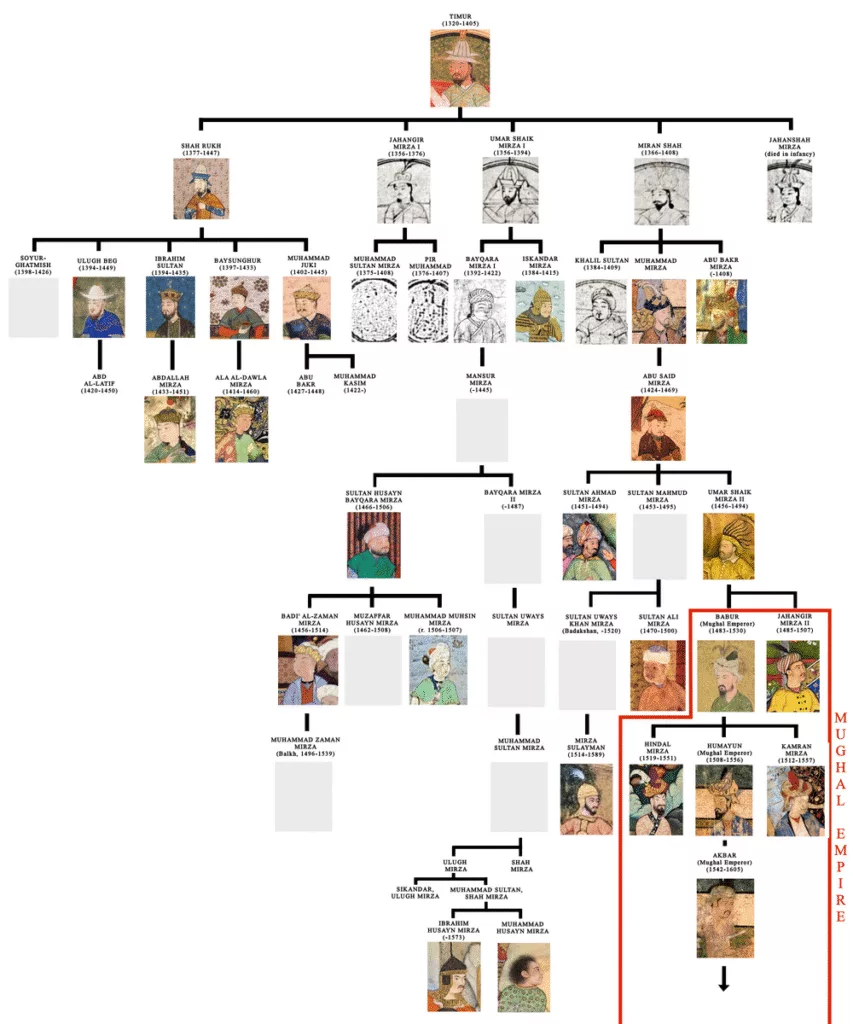
At the top of the chart stands Timur, a powerful conqueror whose empire stretched from the Middle East to India. He established the Timurid dynasty and positioned his descendants as rulers, scholars, artists, and future emperors.
2. Timur’s Sons and the Early Timurid Branches
Timur had several sons, but the chart highlights the most historically significant:
Shah Rukh (1377–1447)
- Timur’s most successful successor.
- Ruled from Herat and transformed it into a cultural capital.
- His descendants maintained power in Persia and Central Asia.
Miranshah (1366–1408)
- Governed western territories, including Azerbaijan and Iraq.
- His line includes several princes but eventually declines.
Umar Shaikh (1356–1394)
- A central figure connecting Timur’s line to the Mughal Empire.
- His descendants ultimately produce Babur, the Mughal founder.
Jahangir Mirza (1356–1376) and Jahanshah Mirza
- Short-lived or lesser-known sons who did not establish long-lasting political branches.
These branches lead to dozens of Timurid princes who ruled regional territories, many shown in the chart, such as Ulugh Beg, Abu Bakr, Ibrahim, Abdallah, and others.
3. The Herat Branch: The Cultural Heart of the Timurids
Under Shah Rukh, the Timurid empire became known for advancements in:
- Calligraphy
- Architecture
- Philosophy
- Science (Ulugh Beg’s astronomical work is legendary)
Key figures in this branch from the chart include:
Ulugh Beg (1394–1449)
- Renowned astronomer and mathematician.
- His observatory in Samarkand was one of the greatest in medieval history.
Abd al-Latif, Abdallah Mirza, Ala al-Dawla Mirza, and others
- These princes represent the complex internal struggles of the Timurid succession.
Further down this branch, the chart shows later Herati rulers including:
- Sultan Husayn Bayqara
- Badi’ al-Zaman
- Muhammad Mu’nis
- Ulugh Mirza, Shah Mirza, and others
These figures oversaw the final phase of Timurid rule in Central Asia before the dynasty’s political power declined.
4. The Rise of the Mughal Empire
The right side of the chart tracks the most globally famous Timurid line — the one that eventually produces the Mughal emperors of India.
Umar Shaikh → Sultan Abu Sa’id → Umar Shaikh Mirza II
From this lineage arises Babur, the man who revives Timurid fortunes.
Babur (1483–1530)
- Great-great-great-grandson of Timur.
- Conquered Delhi and founded the Mughal Empire in 1526.
- His position in the chart marks the merging of Central Asian Timurid blood with Indian Mughal greatness.
Humayun (1508–1556)
- Babur’s son.
- Briefly lost his kingdom but regained it with Persian support.
Akbar (1542–1605)
- Grandson of Humayun.
- One of India’s greatest rulers.
- Expanded the empire, promoted religious tolerance, and strengthened administration.
The chart shows additional Mughal princes:
- Jahangir
- Kamran (Humayun’s brother)
- Hindal
- Mirza Askari
- Sultan Ali Mirza
- Sultan Uways Mirza
These individuals played roles in the turbulent early years of the Mughal dynasty.
5. A Legacy Across Continents
The family tree demonstrates how one dynasty spanned:
- Central Asia
- Persia
- India
- Afghanistan
The Timurids blended:
- Persian culture
- Turkic heritage
- Mongol ancestry
- Islamic scholarship
- Central & South Asian political power
Their architectural, artistic, and political influence continues today in cities like Samarkand, Herat, Delhi, and Agra.