
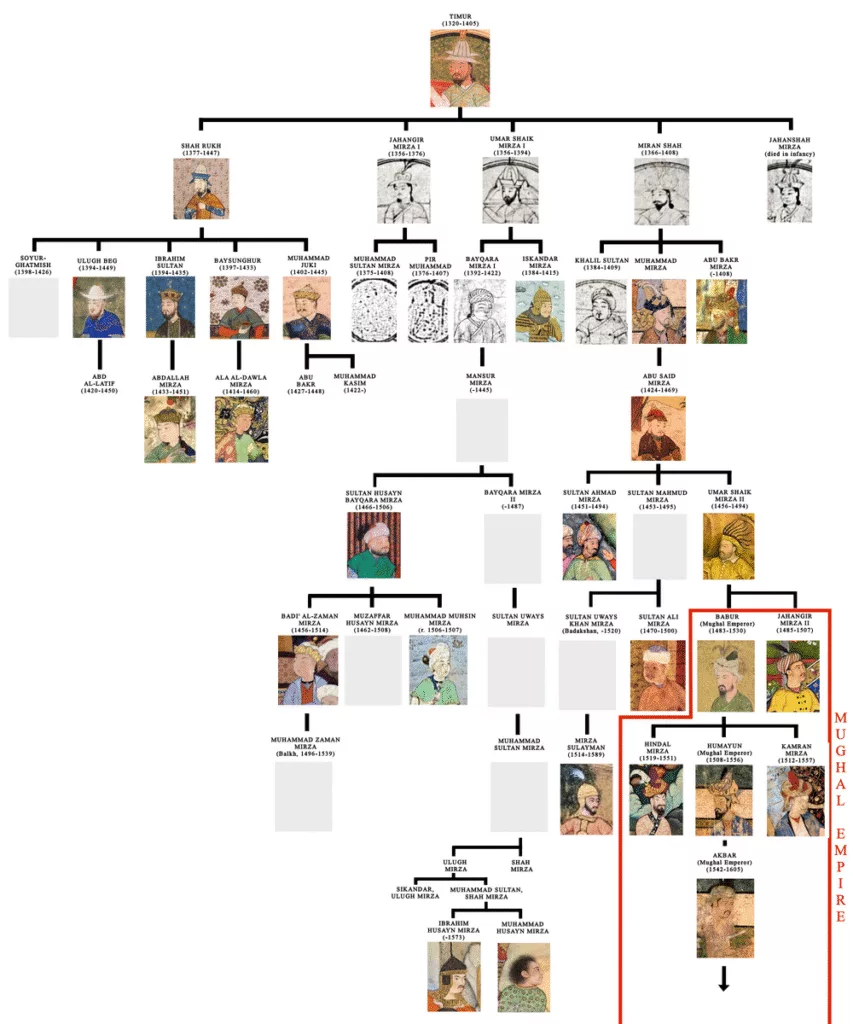
The family tree of Amir Timur (Tamerlane)—one of history’s most powerful conquerors—reveals the remarkable lineage that shaped Central and South Asian empires for nearly three centuries. The chart traces not only Timur’s direct descendants but also the branches that would later give rise to the Mughal Empire in India, forming an extraordinary historical arc: from Samarkand to Kabul, and eventually to Delhi and Agra.
1. Timur: Founder of a Dynasty (1336–1405)
At the top of the lineage stands Timur, the conqueror whose empire stretched from Persia to India. Though he never claimed the Mongol title of “Khan,” he legitimized his rule by marrying into Genghisid families and establishing a dynasty that blended Turkic, Persian, and Mongol traditions.
After his death, political authority shifted to his many sons and grandsons, whose rivalries and ambitions defined the Timurid world.
2. The Second Generation: Timur’s Sons
The chart shows several of Timur’s sons who would become the heads of different branches of the dynasty:
Shah Rukh (1377–1447)
Timur’s most stable and accomplished son, Shah Rukh ruled much of the empire from Herat. His court produced one of the richest periods of Persian art, architecture, and literature.
Jahangir Mirza (1356–1376)
A prominent son whose early death limited his impact but whose descendants—including Muhammad Sultan—played key roles in succession struggles.
Umar Shaikh Mirza (1356–1394)
A valiant prince whose death in battle left young heirs who would later shape Timurid politics.
Miranshah (1366–1408)
Once a favored son, Miranshah later became mentally unstable, leading to political fragmentation.
Jahanshah Mirza (d. in infancy)
Appears briefly in the chart as one of Timur’s lesser-known children.
3. The Third Generation: Princes, Governors & Claimants
The third generation is vast, branching into multiple competing lines:
From Shah Rukh’s Line
- Ulugh Beg (1394–1449) – the famed astronomer and ruler of Samarkand; known more for science than war.
- Ibrahim (1397–1433)
- Baysunghur (1397–1433) – patron of Persian arts.
- Muhammad Juki (1402–1445)
- Abd-al-Latif (1420–1450) – briefly ruler after Ulugh Beg.
- Abdallah (1435–1451)
- Ali al-Dawla Mirza (1417–1460)
- Muhammad Qasim (1433)
From Jahangir Mirza’s Line
- Muhammad Sultan (1374–1403) – Timur’s chosen heir before his untimely death.
From Umar Shaikh Mirza’s Line
- Pir Muhammad (1374–1409) – influential in the early succession wars.
- Iskandar (1384–1415)
- Bayqara Mirza (1394–1408) – ancestor of the powerful Herat branch.
From Miranshah’s Line
- Khalil Sultan (1384–1409) – briefly ruler of Samarkand.
- Abu Bakr Mirza (1380–1408)
- Abd Sa’id (1383–1429)
4. The Fourth Generation: Fragmentation & Rise of Regional Powers
After Timur, the empire splintered. Rival branches competed for Samarkand, Herat, Fars, and Kabul.
Bayqara Line
- Mansur Mirza (†1445)
- Sultan Husayn Bayqara (1438–1506) – a major ruler who established a golden age in Herat.
Shah Rukh → Muhammad Juki Line
- Badīʿ al-Zamān (1459–1510)
- Muhammad Zaman (Reign: 1493–1499)
The Aḥmad & Maḥmud Line
- Sultan Aḥmad Mirza (1461–1494) – ruler of Samarkand.
- Sultan Mahmud Mirza (1453–1495)
- Umar Shaikh Mirza II (1456–1494) – governor of Fergana and father of Babur.
5. The Emergence of the Mughal Empire (Highlighted Red Section)
The right side of the chart marks the birth of a new imperial line: the Mughal (Timurid) dynasty of India.
Umar Shaikh Mirza II → Babur
- Babur (1483–1530) – founder of the Mughal Empire in India; conqueror of Kabul and Delhi.
From Babur came some of India’s greatest emperors:
Babur’s Sons
- Humayun (1508–1556) – restored the Mughal throne after exile.
- Kamran Mirza (1509–1557) – his rival brother.
Humayun’s Son
- Akbar the Great (1542–1605) – one of the greatest rulers in world history; expanded the Mughal Empire across the subcontinent.
This lineage shows the direct continuation of Timur’s bloodline from Central Asia to India, where it flourished for centuries.